 |
| Ramalina cuspidata |
Thursday, 30 April 2015
Ramalina cuspidata
My first fruiticose species under the microscope. The lichen showed 1-septate spores. Ramalina cuspidata is separated from Ramalina siliquose by having round (not flattened) branches, dark ostioles on the pycnidia and blackened thallus base.
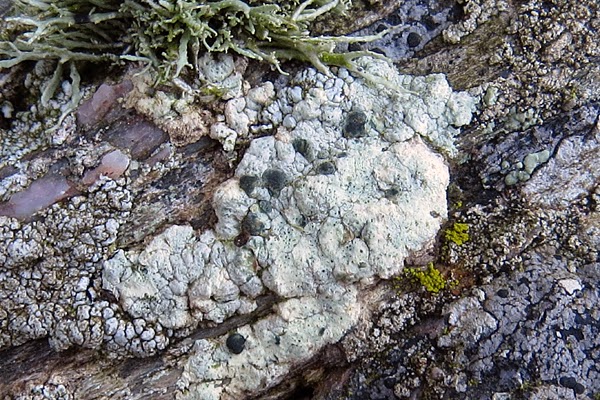
Diploschistes caesioplumbeus
A nice easy one for a change, although looking at it I didn't think it had lecanorine apothecia. The book describes it as urceolate lecanorine.
.jpg) |
| Diploschistes caesioplumbeus through the microscope |
.jpg) |
| Diploschistes caesioplumbeus spore |
.jpg) |
| Diploschistes caesioplumbeus apothecia section |
.jpg) |
| Diploschistes caesioplumbeus |
Unidentified
Another one to come back to in the future. I think this is an easy one but probably looking too hard and can't see past my mistake. Lecanora gangaleoides?
Hymenium 50µm
Epithecium 7.5µm
Spore: 12.5µm
Ascus: Lecanorine?


Hymenium 50µm
Epithecium 7.5µm
Spore: 12.5µm
Ascus: Lecanorine?

 |
| 2.5µm increments |
Wednesday, 29 April 2015
Porpidia cinereoatra
I found this group difficult and for me needed a lot of care and cross checking. The enclosed measurements were needed to get to my conclusion.
Hymenium: 112µm
Epithecium: 20µm
Spores: 15x7.5µm
Hymenium: 112µm
Epithecium: 20µm
Spores: 15x7.5µm
 |
| Porpidia cinereoatra |
 |
| Porpidia cinereoatra section |
 |
| Porpidia cinereoatra section showing 2.5µm ruler |
 |
| Porpidia cinereoatra through microscope |
 |
| Porpidia cinereoatra ascus showing KI reaction |
Rhizocarpon geographicum
Perhaps one of the most colourful lichens this Rhizocarpon geographicum has impressive spores to match it's exterior.
 |
| Rhizocarpon geographicum |
 |
| Rhizocarpon geographicum spore |
Tuesday, 28 April 2015
Porpidia macrocarpa
I had a what looked like a fuscidea ascus type reaction to this lichen which threw me for quite some time. However, if you add up the following you get to Porpidia platycarpoides and Porpidia macrocarpa. These two can be separated by K+ yellow medula on marcrocarpa and K+ red on medula of platycarpoides. There is also a difference in the height of the hymenium of these two. Here are the features of this lichen:
Apothecia up to 3mm
Spores simple and approx 20µm long
Crustose areolate white thallus
Black apothecia
On rocks
Thallus K+ yellow
Apothecia up to 3mm
Spores simple and approx 20µm long
Crustose areolate white thallus
Black apothecia
On rocks
Thallus K+ yellow
 |
| Porpidia macrocarpa |
 |
| Porpidia macrocarpa section |
 |
| Porpidia macrocarpa spore |
 |
| Porpidia macrocarpa ascus KI reaction |
 |
| Porpidia macrocarpa through the microscope |
Porpidia tuberculosa
I couldn't confirm this one under the microscope as it seems I collected mostly podetia. However it does seem likely that this species is Porpidia tuberculosa
 |
| Porpidia tuberculosa |
 |
| Porpidia tuberculosa |
Candelariella coralliza
Almost had this one down as Caloplaca flavocitrina but the K- reaction had me re-thinking. The 32-spored ascus was distinctive which led me to Candelariella of which only 3 species have this number of spores per ascus. The thallus was the eventual key to species level.
 |
| Candelariella coralliza |
 |
| Candelariella coralliza section in K |
 |
| Candelariella coralliza ascus |
Lecanora sulphurea
A distinctive lichen which has lecanorine type apothecia where the exciple becomes excluded. The apothecia are immersed in the thallus and from the whole shot look concolourous with the thallus.
 |
| Lecanora sulphurea |
 |
| Lecanora sulphurea section pre K |
 |
| Lecanora sulphurea post K |
 |
| Lecanora sulphurea through the microscope |
Tephromela atra
Tephromela atra has a few similar looking lichens. T.atra apothecia disks become distorted whereas L.gangaleoides does not. In section the purple coloured hymenium is distinctive for this species.
 |
| Tephromela atra |
 |
| Tephromela atra hymenium |
 |
| Tephromela atra section after K added |
Monday, 27 April 2015
Ramalina siliquosa
No very familiar with this group. Ramalina features are:
- Branching without fragile branchlets
- Apothecia if present concolourous with thallus
- Branches solid
 |
| Ramalina siliquosa |
Unidentified
One to come back to in the future. I can't see any crystals in the exciple to make it a Lecanora. The other option could be Protoparmelia.


 |
| spore |
 |
| apothecia section pre K |
 |
| apothecia section post K |


Opegrapha calcarea
Should be getting good with Opegrapha's by now but still took quite some time with this one. Ascospores measured 15µm long and 3-septate.
 |
| Opegrapha calcarea |
 |
| Opegrapha calcarea |
 |
| Opegrapha calcarea spores |
Sunday, 26 April 2015
Buellia subdisciformis
Despite the distinctive section I had trouble with this. Keying out left me with Amandinea, Buellia and Dactylospora. The presence of hyphae eliminated Dactylospora which is said to be a linchenicolous fungi.
.jpg) |
| Buellia subdisciformis section showing hyphae and spores |
.jpg) |
| Buellia subdisciformis section |
.jpg) |
| Buellia subdisciformis |
Caloplaca maritima
This one keyed out well for Caloplaca maritima in TLGBI. At first I wasn't sure of the apothecia type as you can see below but the K crimson reaction gave it's ID up as a Caloplaca species.
 |
| Caloplaca maritima |
 |
| Caloplaca maritima |
 |
| Caloplaca maritima section |
Ochrolechia parella
A distinctive lichen and just as so under the microscope. The ascus was very thick walled and the spores measure 45-75µm long. The epithecium is C+ red, a useful tip in the field.
 |
| Ochrolechia parella |
 |
| Ochrolechia parella ascus |
 |
| Ochrolechia parella spore |