 |
| Hygrophypnum ochraceum |
Wednesday, 28 September 2016
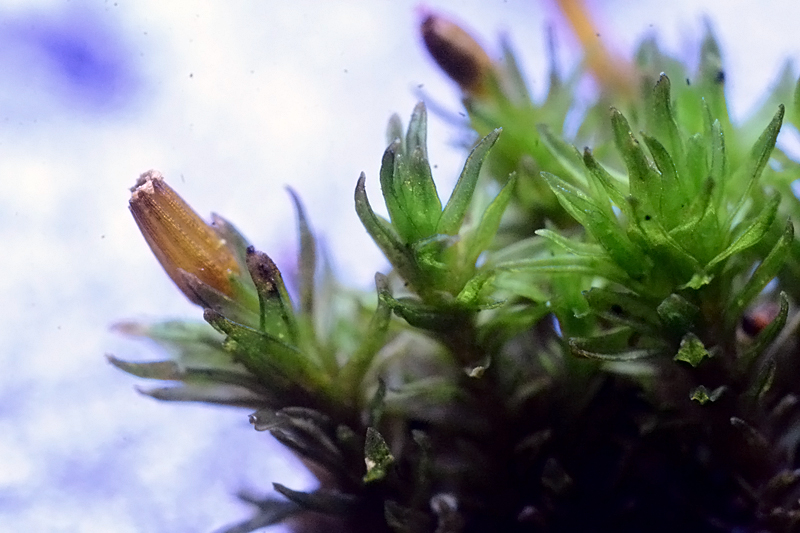
Hygrohypnum ochraceum
At first glance you'd be forgiven for thinking you've found a Hypnum but on closer inspection the presence of a costa is revealed and in this case a forked costa that runs a little over 50% of the leaf. Keying out can be misleading as the stumbling block comes when judging the costa length; if 50% or more you are taken down the wrong part of the key. Once you are aware of this Hygrohypnum becomes the obvious choice. Hygrophypnum ochraceum is tricky to separate from H.luridum in the field but under the compound microscope the presence of inflated colourless alar cells confirms Hygrophynum ochraceum.

Thursday, 22 September 2016
Orthotrichum
Orthotrichum mosses are best identified when bearing capsules but as an exercise I decided to have a go at this one and see how far it could be narrowed down. Firstly Orthotrichums on trees can be characterised by their recurved leaf margins sometimes the entire length of the leaf. In the photo below you can see that the leaf tips are quite distinctive too beyond the recurved margin and the nerve is protruding which is also visible in the leaf section in the inset. With the specimen below the leaves were wide spreading with the basal quater curving and the remainder straight.
Elimination: O.anomalum, O.cupulatum, O.rupestre were all eliminated because they grow on rock and mine was on a branch. O.pulchellum has the leaves twisted when dry and O.tenellum has the leave flexuose when dry so these were eliminated too. O.diaphanum has a white hair point so not that one. Others were ruled out on leaf shape and Lyellii due to lack of gemmae. We are now left with a choice of three: O.stramineum, O.affine and O.striatum.
Elimination: O.anomalum, O.cupulatum, O.rupestre were all eliminated because they grow on rock and mine was on a branch. O.pulchellum has the leaves twisted when dry and O.tenellum has the leave flexuose when dry so these were eliminated too. O.diaphanum has a white hair point so not that one. Others were ruled out on leaf shape and Lyellii due to lack of gemmae. We are now left with a choice of three: O.stramineum, O.affine and O.striatum.
 |
| Orthotrichum affine found nearby the mystery Orthotrichum |
 |
| Orthotricum sp. |
Tuesday, 5 April 2016
Parmotrema reticulatum
Always seem to struggle with foliose lichen so the best way to get good at them is to keep trying. First clues were with UV and chemical tests. There was a faint UV+ purple, C- and K+ yellow turning red. Visually the upper surface showed many fine cracks showing the white medulla and the underside was mainly black with brown lobe tips. The rhizines present are simple and fading towards the lobe margins but the lobe tips had some sparse simple rhizines. Overall this was enough information to key out this foliose lichen to Parmotrema reticulatum.
 |
| Parmotrema reticulatum underside of lobe |
 |
| Parmotrema reticulatum upper side of lobe |
Fuscidea lightfootii
Found this morning on a wooden gate. Only a single simple spore was found with 1µm epispore measuring 10x7.5µm not enough to to be certain of identity. If this was a typical spore then Lecidella elaeochroma f soralifera a contender but tests show it to be something else. The thallus was UV+ white and C- suggesting something more like perhaps Fuscidea lightfootii. However, when performing a second section on a younger looking apothecia I found multiple dumbel shaped spores which were typical of Fuscidea lightfootii measuring 8x3.5µm
 |
| Fuscidea lightfootii |
Thursday, 31 March 2016
Rhizocarpon lavatum?
It doesn't take much effort to determine a Rhizocarpon but getting to species level is a lot more difficult. This one wouldn't key out so I instead went with the closest match. No idea what the difference between muriform, submuriform and eumuriform is and no explanation in the book. Perhaps it would have been easier to reach an ID had I have known. I've put the details here to come back in time and re-evaluate:
Spores: muriform (or could be submuriform or eumuriform) 25x11.25µm turning brown when mature.
Ascus: 120µm
hypothecium: brown
hymenium: colourless
epithecium: brown
apothecia: 0.8mm
habitat: siliceous rocks near stream
Spores: muriform (or could be submuriform or eumuriform) 25x11.25µm turning brown when mature.
Ascus: 120µm
hypothecium: brown
hymenium: colourless
epithecium: brown
apothecia: 0.8mm
habitat: siliceous rocks near stream
 |
| Pos Rhizocarpon lavatum |
Wednesday, 30 March 2016
Caloplaca from Brecon Beacons 25th March
Found on 25th March 2016 on a gate post this Caloplaca was not found to be identifiable with my level of expertise currently. A shortlist was drawn up using apothecia size (1mm) and habitat giving Caloplaca citrina as the best guess. Both the thallus and apothecia are K+ purple eliminating C. virescens and C.cerina. Apothecia colour elimnated herbidella. There were few polaricula spores the largest measured 15x4.5µm. Some of the paraphyses had swollen tips measuring 3.75µm


Wednesday, 7 October 2015
Lecanora pulicaris
Lecanorine apothecia up to 1mm
Thallus white crustose K+ yellow
Spores 15x7µm simple
Fine crystals extending from the epithecium into the hymenium seen with a polarizing filter.
Massive crystals in the exciple.
Thallus white crustose K+ yellow
Spores 15x7µm simple
Fine crystals extending from the epithecium into the hymenium seen with a polarizing filter.
Massive crystals in the exciple.
 |
| Lecanora pulicaris |
Subscribe to:
Posts (Atom)