Showing posts with label bryophytes. Show all posts

Tuesday, 4 December 2018

Ceratodon purpureus

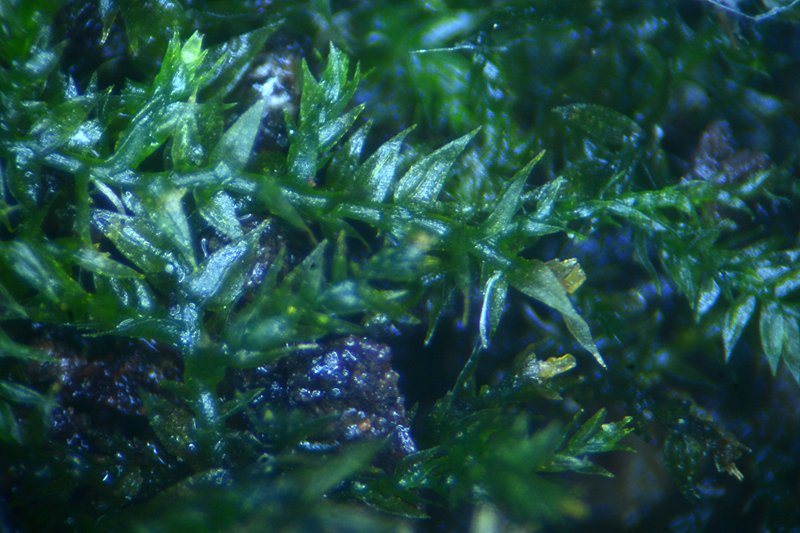
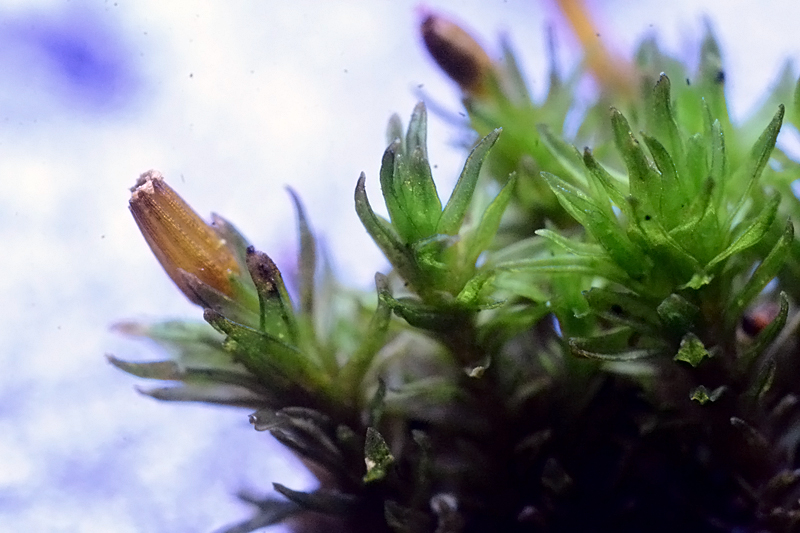
Found on a thatched roof in Dorset this bryophyte I first thought was Dicranoweissia cirrata but it had dentate leaf tips. Because of this Bryoerythrophyllum recurvirostrum was considered but this species has papillose leaf cells and doesn't grow on thatched rooves. After consulting experts it was discovered that this species was indeed Ceratodon purpureus. The leaf state when dry prevented me from keying out correctly.
Ceratodon purpureus wet

Ceratodon purpureus dry

Ceratodon purpureus leaf

Ceratodon purpureus leaf section

Monday, 8 October 2018

Ephemeral mosses

I found some small ephemeral bryophytes on a reservoir bank on the weekend. The options were: Pseudephemerum, Ephemerum, Archidium and Pleuridium. I found the key to separate these not that great so have put a few notes here. Pleuridium stands out from the others by having a wide base to the leaf sharply narrowing to a mostly long needle like leaf. Archidium should have non fertile shoots with short sharply pointed leaves, quite distinctive when familiar with. This leaves separating Pseudephmerum and Ephemerum. Pseudephemerum has costate and untoothed leaves whereas the most common Ephemerum (minutissimum) has dentate leaves with no costa. Some of the more uncommon Ephemerum are costate and without maginal teeth. Perhaps only E.recurvifolium with its oblique apiculus of the capsule can be done in the field. Separating the rest may depend on the amount of magnification you have as these plants are tiny. Ephemerum sessile for example can be separated from P.nitidum by spore size; 20-32µm in P.nitidum and 60-80µm in E.sessile. The leaves look longer and thinner on E.sessile compared to P.nitidum so I suspect familiarity with these groups could be useful in the field.

Pseudephemerum nitidum

Ephemerum minutissimum showing the dentate leaf

Wednesday, 6 December 2017

Didymodon tophaceus

This is one I found this morning on the coast. Under the microscope the leaves look distinctive having the shape similar to a Zygodon with the costa being in a channel. I eventually identified it as either Didymodon luridus or Didymodon tophaceus. It was a bit of a tough call but eventually I went with Didymodon tophaceus because of the leaf shape and the habit of the leaves when dry as D.luridus has appressed leaves when dry and D.tophaceus has it leaves incurled and slightly twisted.

Didymodon tophaceus

Didymodon tophaceus leaf

Tuesday, 5 December 2017

Didymodon fallax

Keyed this one out as Didymodon fallax and comparing photos on the internet it looks OK. Here are shots of it in wet and dry state.

Didymodon fallax dry

Didymodon fallax wet

Rhynchostegium murale

A species found most commonly on rock with deeply concave leaves. Often fertile with a subulate beak and smooth seta.

Rhynchostegium murale

Monday, 4 December 2017

Cirriphyllum crassinervium or Rhynchostegium confertum

An expert bryologist ID'd a plant for me as being C.crassinervium yesterday but upon checking it the next day I couldn't make out the dinner plate shaped leaves and the basal half of the costa was not thick. Running it through the key I notice that Cirriphyllum has strongly papillose setae which mine didn't plus the lid was subulate and not rostrate. Eventually the key ran me to Rhynchostegium and it quickly became apparent that my specimen was in fact Rhynchostegium confertum.

Rhynchostegium confertum

Friday, 10 November 2017

Didymodon vinealis

Growing on a stone on a wooded slope made Didymodon vinealis a suitable candidate for this one. The lower leaves were darker than the upper and when dry they looked appressed to the stem. Under the microscope the cells over the costa in the upper part of the leaf were quadrate.

Didymodon vinealis

Tuesday, 4 April 2017

Dicranodontium denudatum

Here's a species that is potentially overlooked and at first site you could be forgiven for thinking this is Dicranella heteromalla. It's not mentioned in the book as a similar species but that's exactly what it was called by an expert bryologist until he got it under the microscope. A distinguishing feature is the deciduous shoots but when absent it can hamper a safe ID. Under the microscope the basal cells will help separate D.denudatum from Dicranella heteromalla.

Dicranodontium denudatum

Scleropodium tourettii or Cirriphyllum crassinervium

This was an interesting one as this sample was identified in the field by a professional bryologist as Cirriphyllum crassinervium so in theory it should have been straight forward to key out. However, after running through the key it became apparent that it doesn't key to Cirriphyllum crassinervium. The leaf tip was the first problem being obtuse and not abruptly contracting to leave a short apiculus. This avenue led me then to chose between Rhynchostegium and Scleropodium. The key says that Scleropodium has differing sizes in stem and branch leaves whereas Rhynchostegium has them all the same size. I could see varying leaf sizes so opted for Scleropodium. This group only has two species which can be separated by habit when wet and dry plus S.tourettii has much more concave leaves than S.cespitans looking more like Pseudoscleropodium purum. This species can be eliminated by the long pinnate growth unlike the bushy matted like habit of S.tourettii. So we have an ID but look again the the thick costa in the basal half, this is typical of C.crassinervium and with the concave leaves with the flattened border we find out that it is C.crassinervium after all. As a postscript it is worth mentioning that Rhynchostegium murale is a similar looking plant and should be considered when identifying in the field perhaps.

Cirriphyllum crassinervium

Friday, 9 December 2016

Rhynchostegiella pumila

My biggest weakness in bryophytes is pleurocarps currently so thought I'd start to tackle this group. The first one wasn't easy and having three names didn't help matters either, the other two being Eurhynchium pumilum and Oxyrrhynchium pumilum.
Working through the keys down all uncertain avenues brought me to Scorpiurium circinatum, Amblystegium serpens, Conardia compacta and Oxyrrhynchium hians/speciosum. The two Oxyrrhynchium species were eliminated by their cell length. both are 40µm long whereas mine was only half that. Scorpiurium was ruled out straight away with S.circinatum have appress leaves when dry and not only this both plants look completely different. Amblystegium serpens was ruled out by having a longer narrower leaf shape. Conardia compacta looks quite close but this species has a costa that runs almost to the leaf tip and rhizoidal growth from the back of the costa.

Rhynchostegiella pumila

Rhynchostegiella pumila through the microscope

Wednesday, 28 September 2016

Hygrohypnum ochraceum

At first glance you'd be forgiven for thinking you've found a Hypnum but on closer inspection the presence of a costa is revealed and in this case a forked costa that runs a little over 50% of the leaf. Keying out can be misleading as the stumbling block comes when judging the costa length; if 50% or more you are taken down the wrong part of the key. Once you are aware of this Hygrohypnum becomes the obvious choice. Hygrophypnum ochraceum is tricky to separate from H.luridum in the field but under the compound microscope the presence of inflated colourless alar cells confirms Hygrophynum ochraceum.

Hygrophypnum ochraceum

Thursday, 22 September 2016

Orthotrichum

Orthotrichum mosses are best identified when bearing capsules but as an exercise I decided to have a go at this one and see how far it could be narrowed down. Firstly Orthotrichums on trees can be characterised by their recurved leaf margins sometimes the entire length of the leaf. In the photo below you can see that the leaf tips are quite distinctive too beyond the recurved margin and the nerve is protruding which is also visible in the leaf section in the inset. With the specimen below the leaves were wide spreading with the basal quater curving and the remainder straight.
Elimination: O.anomalum, O.cupulatum, O.rupestre were all eliminated because they grow on rock and mine was on a branch. O.pulchellum has the leaves twisted when dry and O.tenellum has the leave flexuose when dry so these were eliminated too. O.diaphanum has a white hair point so not that one. Others were ruled out on leaf shape and Lyellii due to lack of gemmae. We are now left with a choice of three: O.stramineum, O.affine and O.striatum.
Orthotrichum affine found nearby the mystery Orthotrichum

Orthotricum sp.


Friday, 4 September 2015

Oxyrrhynchium hians

Oxyrrhynchium hians is a common pleurocarp which can be identified quite readily with care and a good hand lens in the field. With the example below I could see through the hand lens the nerve extending past the half way mark but not reaching the tip and the margin of the leaf toothed. A good feature for O.hians is the leaves being spaced out along the stem.

Oxyrrhynchium hians leaf

Oxyrrhynchium hians

Sunday, 30 August 2015

Woolly Fringe-moss - Racomitrium lanuginosum

Found on Dartmoor this common species is quite forward to identify. Under the microscope the long wavy cells identify the group as Racomitrium. Grimmia also has wavy cells but these are short. Racomitrium lanuginosum has 90 degree projections on the white hair point which is visible with a high powered magnifying glass.

Racomitrium lanuginosum

Racomitrium lanuginosum long wavy cells

Racomitrium lanuginosum close up of hair point

Thursday, 30 July 2015

Brean Down 29th July

I've hardly been to Brean Down this year so thought it would be a nice change to have a look round and see what I could find. As it turned out there were a few discoveries of things new to me including: Weissia brachycarpa, Dermatocarpon miniatum, Ochesella villosa, Cryptocephalus fulvus and Squamapion atomarium.
I started off by examining the wall next to where I parked and found Bilimbia sabuletorum plus two bryophytes that looked like Ulota crispa and a Tortula sp. At the bottom of the steps I ran into Bugloss for the first time this year. This plant stood out with it's large prickly leaves and small blue solitary flowers. Half way up the steps I strayed on to the grass and instantly started to find some interesting things. Here I found the Weissia brachycarpa growing on soil on an overhang. The leaves were 1mm long and the old capsules still present which helped with the identification. I also found three Cryptocephalus fulvus in this area, a very striking beetle but very small so crawling round on hands and knees recommended. The crescent shaped gemmae cups weren't visible so perhaps not a feature to be looked for all year round.
Eventually I reached the top and made my way westwards but only managed a short distance before finding a new lichen, Dermatocarpon miniatum. This is a distinctive brown foliose lichen with lots of brown dots which I presume are the 0.3mm perithecia.
I also found here Black Meddick which intially gave me trouble identifying as I thought it was Clover to start with but the leaves end in a small point.

Black Meddick

Cryptocephalus fulvus
Weissia brachycarpa

Dermatocarpon miniatum

Wednesday, 3 June 2015

bryum pseudotriquetrum

On the subject of Bryums it seems a good idea to have a go at this one too. Same leaf shape but this one has a border ruling out B.caespiticium. To me I'd say this one is Bryum pseudotriquetrum

Bryum pseudotriquetrum capsule

Bryum pseudotriquetrum leaf

Bryum pseudotriquetrum leaf tip

Bryum caespiticium

This bryophyte I had a go at from the Garden Bioblitz as it was in a flower pot in my garden. As I found out during the process Bryum's are a tricky group and not really for beginners. However I persevered.
I listed the possibilities based on distribution and then eliminated one by one:

pallens - Leaves wrong colour although there is a green form.
capillare - Leaves twisted when dry
donianum - Leaves curl when dry
caespiticium - A likely candidate
pseudotriquetrum - Leaf has margin.
dichotomum - Setae less than 15mm (mine measures 35mm)
argenteum - Round leaf
radiculosum - Has tubers
rubens - Has tubers

Bryum caespiticium spores

Bryum caespiticium leaf

 Bryum caespiticium sporophyte

Bryum caespiticium peristome


Wednesday, 27 May 2015

Ulota crispa

Slow but steady progress on bryophytes. Not a good time of year to be studying them as most are dried out but there are still one's that can be done. This Ulota crispa was characterised by the curled distorted leaves when dry and the hairy calyptra (sheath over the capsule).

Ulota crispa leaf

Ulota crispa mid leaf cells

Ulota crispa basal leaf cells

Ulota crispa leaf tip

Ulota crispa

Wednesday, 20 May 2015

Campylopus introflexus

Found in a flower pot in the back garden this species is said to have reflexed hairpoints when dry.

Campylopus introflexus capsule

Campylopus introflexus

Campylopus introflexus leaf

Monday, 18 May 2015

Orthotricum anomalum

This specimen is quite dried out but had few new growths so thought it would be worth a go. After some three hours of deliberation I came up with the conclusion that it is Orthotrichum anomalum

Orthotrichum anomalum peristome teeth

Orthotrichum anomalum

Orthotrichum anomalum leaf